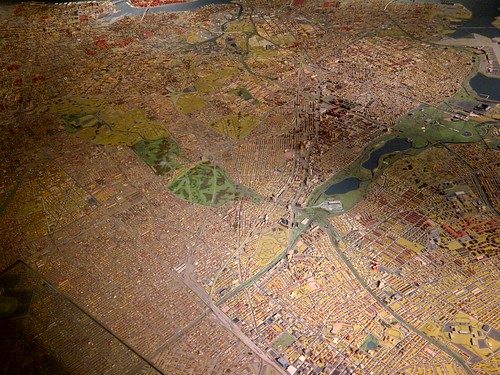
Before the second birthday dinner, meli trekked out to Queens again. This time we visited the Queens Museum to especially see Community Ofrenda: Where Memory Becomes Home and the Panorama of the City of New York (where I got to show off my knowledge of NYC). While there we also saw Hidden Altars of Grief and Remembrance, the Relief Map of the NYC Water Supply System,Sonia Boyce: Demonstrate, (which had an endless loop of a group singing resistance songs in the museum – the people who work there must be going insane listening to it over and over and over), the 1939 and 1964 World’s Fair Collection, The Neustadt Collection of Tiffany Glass, and About Us: The American Imagery. The current exhibits like the Community Ofrenda, Hidden Altars, and American Imagery will be up until February. The Panorama, NYC watershed relief map, World’s Fairs, and Tiffany Glass exhibits are part of the Queens Museum collection. Until January is a film Collection Spotlight: The Panorama Archives highlighting the Panorama updates, which were done yearly until the mid-1970s fiscal crisis, and the 1992-1994 major renovation.
The ofrenda was very pretty and the other artwork representing those lost to state violence very powerful.
A few photos from Community Ofrenda and Hidden Altars: (I tried to get the artists’ names above each photo but I am not skilled enough with this to make it work correctly.)


Gabriel Garcia Roman: Danny Aros: Katherine Miranda: Danny Aros:
Lorena Mas allá del sol Triunfamos (La ultima vez) White Frame


Odette Chavez-Mayo: Todo los santos (top)
Madre Coatlique, cuida a nuestros antepasados Niceli Portugal: Mujer Frontera (and detail)


 Next exhibit was the NYC watershed relief map. Inside was a Wame Nohtóe Chemacheg, a miniaturized mishoon carved by Shinnecock artist Shane Weeks (traditional name is Bizhiki Nibauit).

American Imagery was curated by three Terra Foundation Fellows and contains photographs from American and non-American artists with the exhibit trying to answer the question of what it means to be American and it is divided into three parts.
Being almost immediately greeted by Mick Jagger seems to not answer the question but maybe it does.

I especially liked the photos of WPA art. There was a huge mural in the post office in our neighborhood that was a WPA project and while my mother stood on line, I would stare at the mural. There were photos of men building tunnels and bridges, factory workers, small towns, and big cities.
These are both labelled unknown artist, which is a shame. 


Fred McDarrah’s portrait of a woman working at Cedar Tavern.

Upstairs was a lot of memorabilia from the two NYC World’s Fairs but I only took a photo of the 1964 World’s Fair diorama. 
I did not take any photos of the Panorama (or of the Tiffany collection). I have been there a few times – the first time was when I was in grade school. Then you could walk close to it and it was about kid height. As buildings were built or torn down, they would update it. With the renovations, now there is a raised platform, so you look at the Panorama from above and you cannot get too close to it. The planes are still taking off and landing at La Guardia. And the World Trade Towers still stand. I showed meli where in Queens I lived and told her about the moraines where the glaciers stopped on Long Island and dropped all their debris and when Brooklyn and Queens were first settled, northern Long Island was no good for farming, so most that land became cemeteries and parks. I thought the film about the renovation of the Panorama was interesting.
When we first entered the museum, we walked through Demonstrate, which was a series of videos and visual art about resistance and freedom and one repeating video of singers walking through the museum. No matter what part of the museum we were in, we could hear the singing.


Hanging out with meli is always fun and a treat. Plus we got to see some nice art, visit my city all at once, and listen to endless singing.
By Carene Lydia Lopez